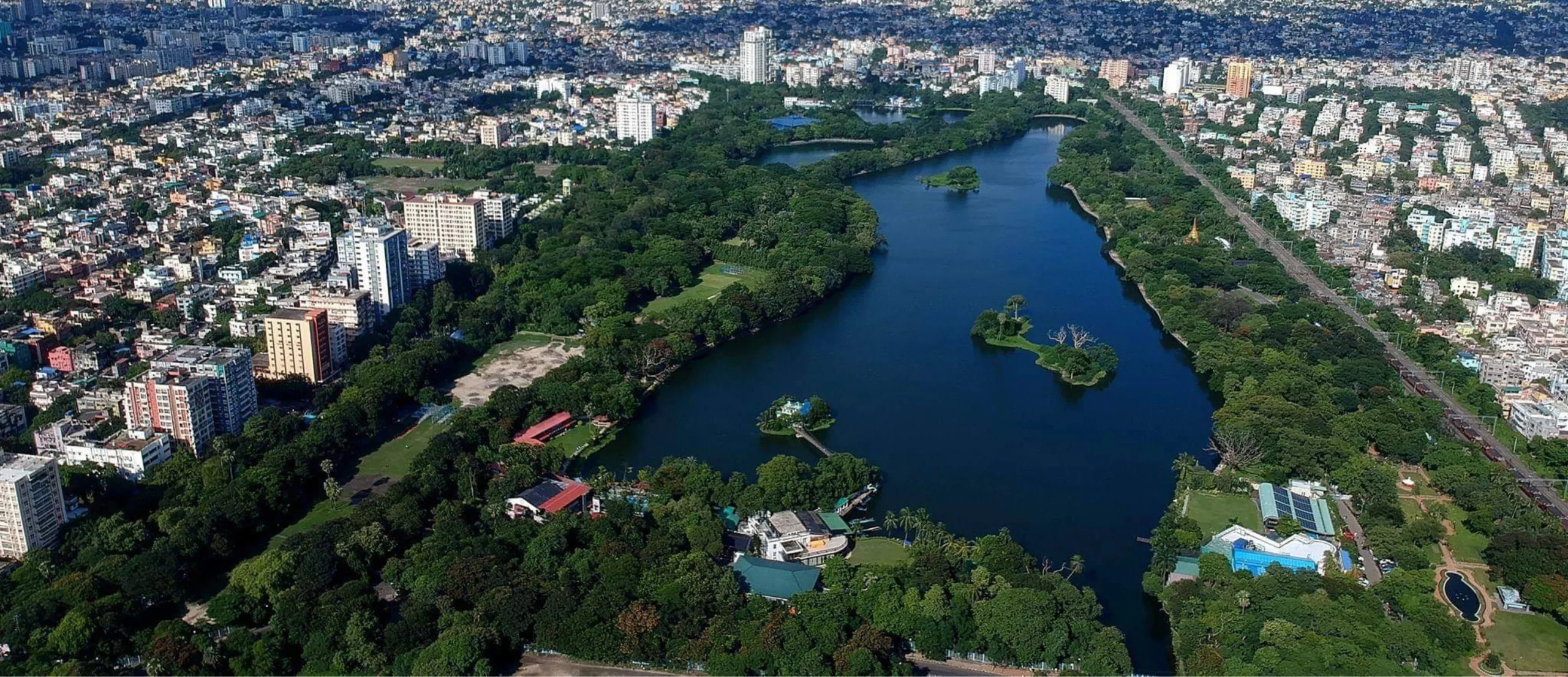
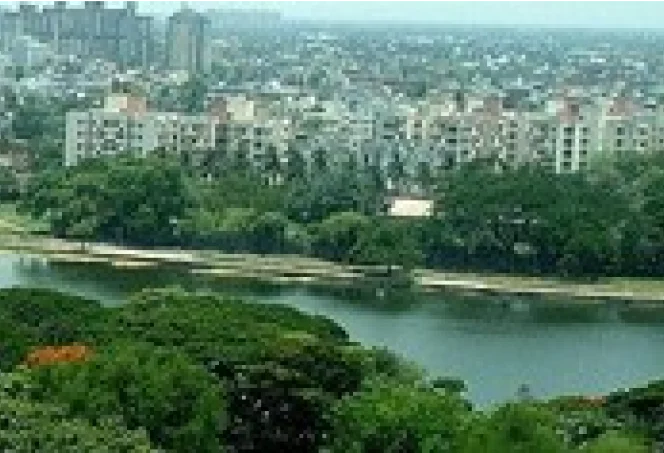
Rabindra Sarobar is a 73-acre human-made lake excavated in the early 20th c. in southern Calcutta’s and has attained a national lake status owing to its ecological importance.
Curated by
Suchandra Bardhan
Introduction
Starting its journey as Dhakuria lake in the Dhakuria (possibly derived from Thakuria) neighbourhood of south Kolkata, Rabindra Sarobar is a man-made lake excavated in the early 20th century. by the erstwhile Calcutta Improvement Trust (CIT) as part of the city’s southward expansion. It is now a significant environmental and bio-reserve of Kolkata in general, and south Kolkata, in particular.
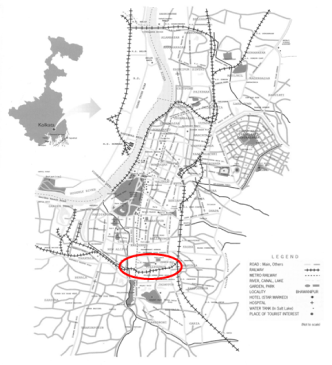
Location of Rabindra Sarobar in Kolkata
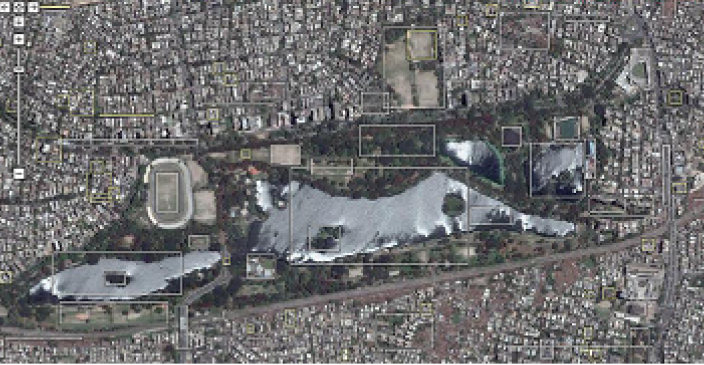
Satellite Image of Rabindra Sarobar showing the dense urban surroundings (source: Google Maps)
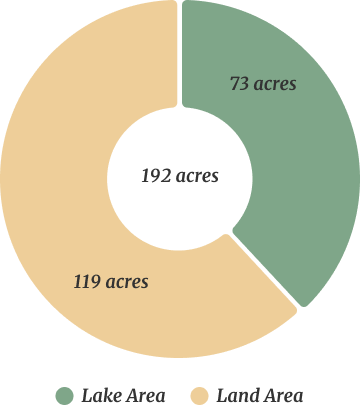
Area Distribution of Rabindra Sarovar Lake
Total Area 192 acres
Leased out land area 42 acres
Tree Density (1989) 27.5 per acre
Tree Density (2007) 19.0 per acre
Inception
“The picturesque Dhakuria lake landscape has a semblance of the 18th-century English Romantic gardens, complete with its informal layout, tree-lined water-edge, and the islands.”
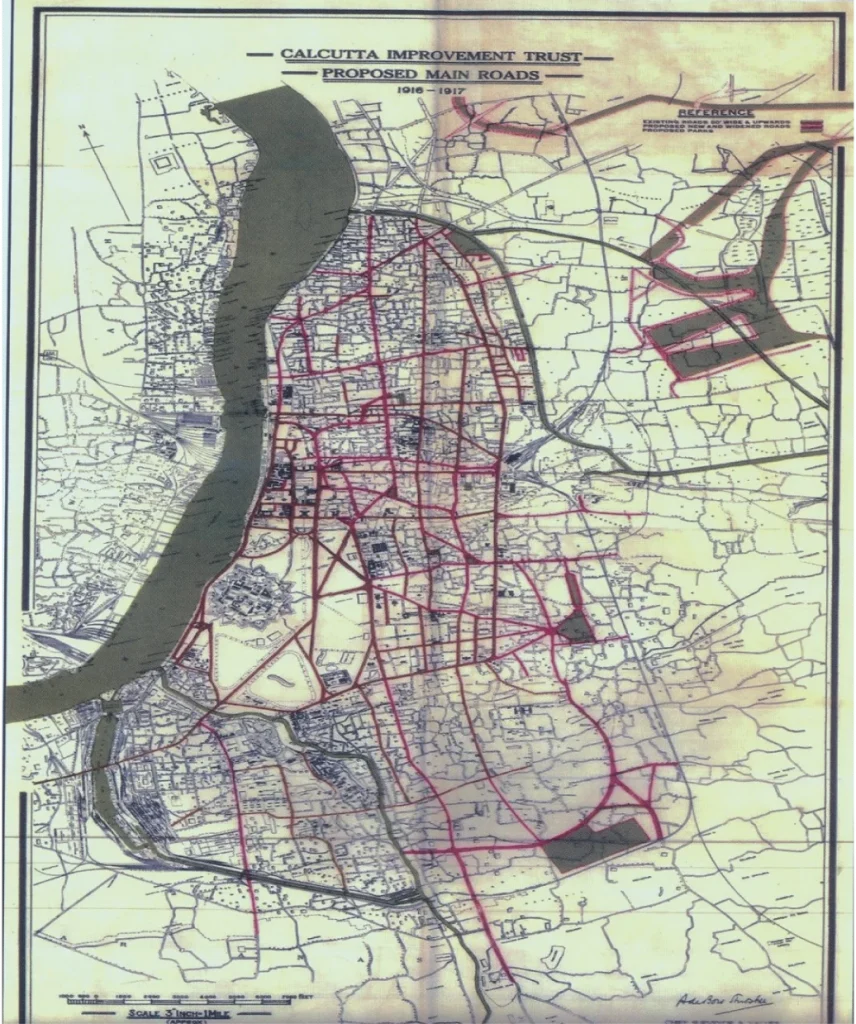
Rabindra Sarobar was conceived in 1916-’17 and laid out in the 1920s by CIT [later Kolkata Improvement Trust or KIT] in the low lying village of Mudiali to the south of Calcutta, under its road development and urban greening schemes. This part was the southern end of the city back then. A road to the N-E of the Sarobar is named South End Park Road – a toponymic reminder of the city’s past extent.
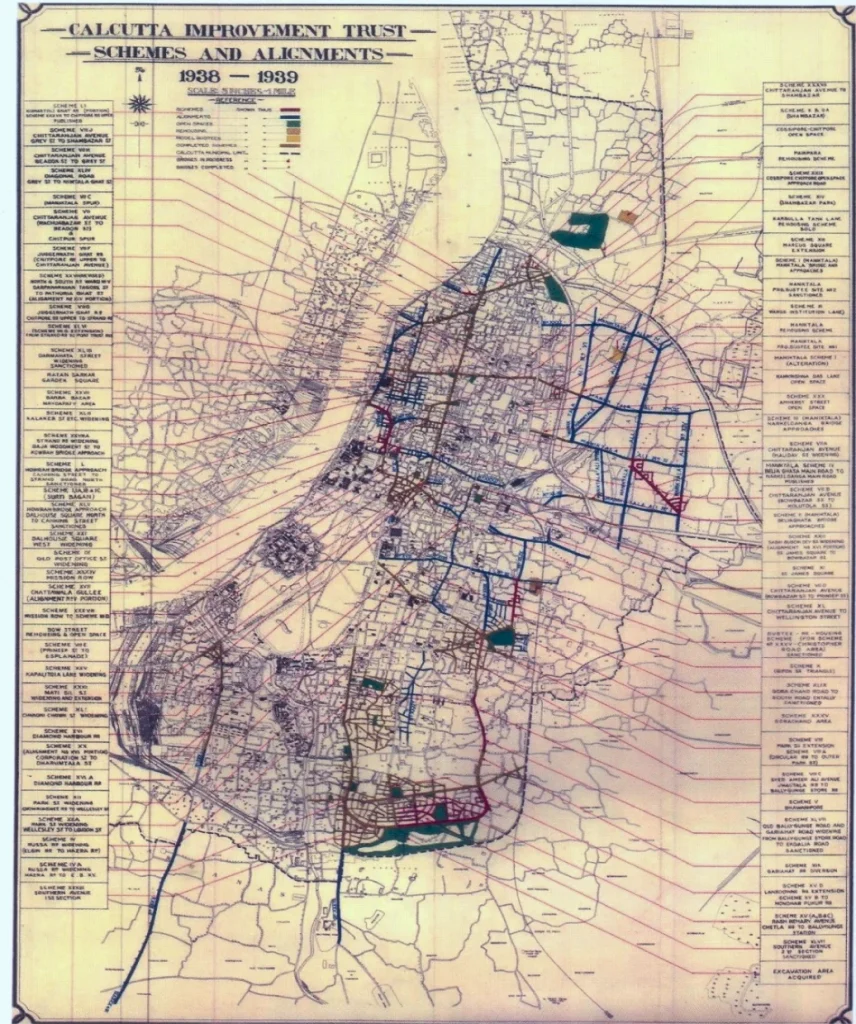
The CIT maps presented here are about 20 years apart and testifies how a well-considered urban planning initiative can be brought to fruition. The second map (1938-39) marks the Rabindra Sarobar, then Dhakuria lake, as ‘EXCAVATION AREA ACQUIRED’. The Southern Avenue road development was a contiguous scheme and marked as CIT scheme no. XLVII in the map (Chattopadhyay, 013).
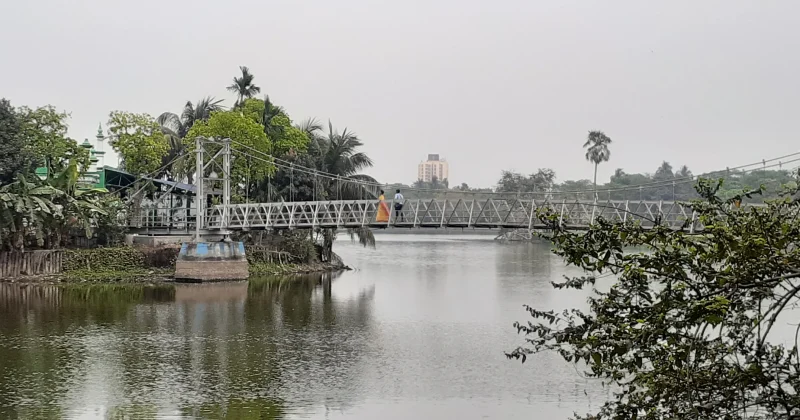
The picturesque Dhakuria lake landscape has a semblance of the 18th-century English Romantic gardens, complete with its informal layout, tree-lined water-edge, and the islands. In 1926, the cable suspended bridge erected by Burn & Co., Howrah was installed to connect the mosque-island with the mainland.
CIT’s proposed improvement plan of 1938-39 where Rabindra Sarobar is shown as ‘open space’. (Source: Chattopadhyay, 2013)
CIT’s scheme for proposed road network and parks, 1916-’17 (Source: Chattopadhyay, 2013). Identification of potential park locations can be seen in present day Rabindra Sarobar (blue dotted ellipse) and Park Circus, among other areas.
Genesis
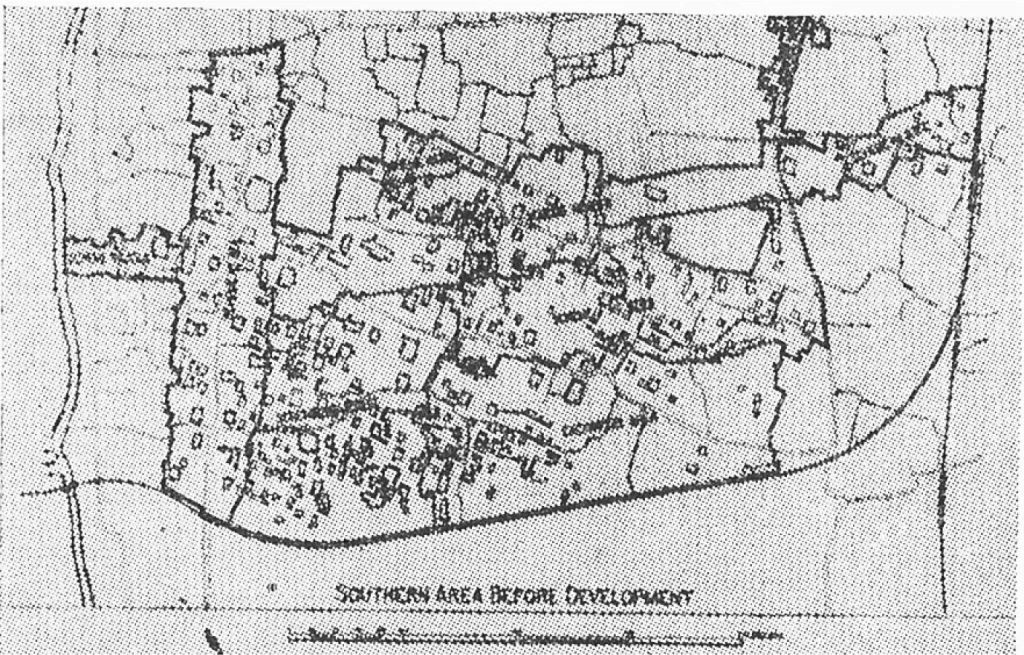
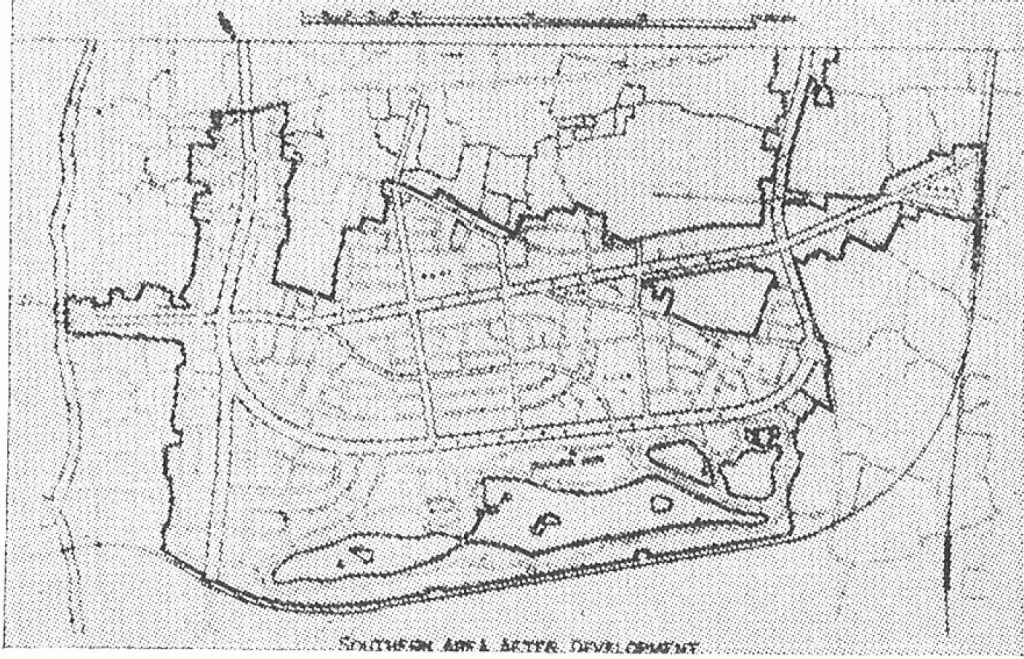
The maps here show the BEFORE-AFTER development of the place and how a rural settlement transformed into the present day road network, the lake and adjoining residential neighbourhood.
The Dhakuria lake precinct was identified to house a number of recreational facilities under CIT Scheme LXXIV in May 1958 and was renamed Rabindra Sarobar as a homage to Kabiguru Rabindranath Tagore (1861-1941), the first Nobel Laureate of Bengal.
Calcutta Improvement Trust’s map of ‘SOUTHERN AREA BEFORE DEVELOPMENT’ . The author has superimposed the blue dash lines representing the lake profile on the map to understand the pre-excavation site. (source: Prof. Monideep Chattopadhyay’s archive)
Calcutta Improvement Trust’s map of ‘SOUTHERN AREA AFTER DEVELOPMENT’
(source: Prof. Monideep Chattopadhyay’s archive)
Thenceforth, Rabindra Sarobar underwent the following interventions:
1962: The cable suspended bridge was strengthened by Burn & Co., Howrah.
Early sixties: Construction of 26,000 capacity Stadium at the N-W corner.
1980: Construction of 3,500 capacity open air theatre (OAT).
1985-89: Installation and operation of the Toy Train, the tracks of which still circumscribe the lake.
1991: Conversion of the OAT into a covered auditorium for the 10th International Film Festival in Kolkata, and named Nazrul Mancha.
The Pristine Natural Beauty of Rabindra Sarobar
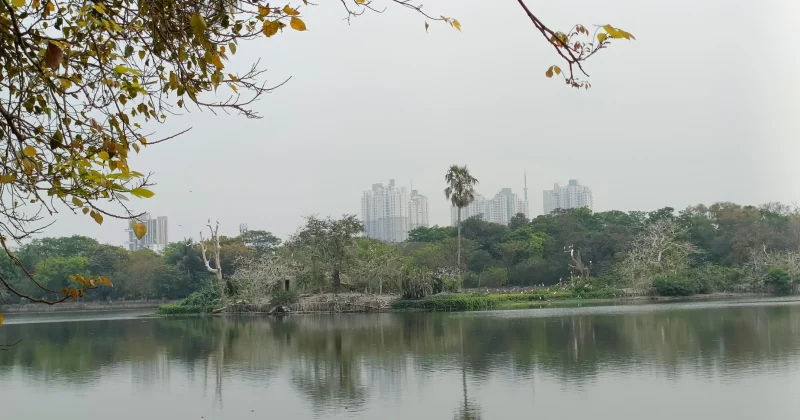
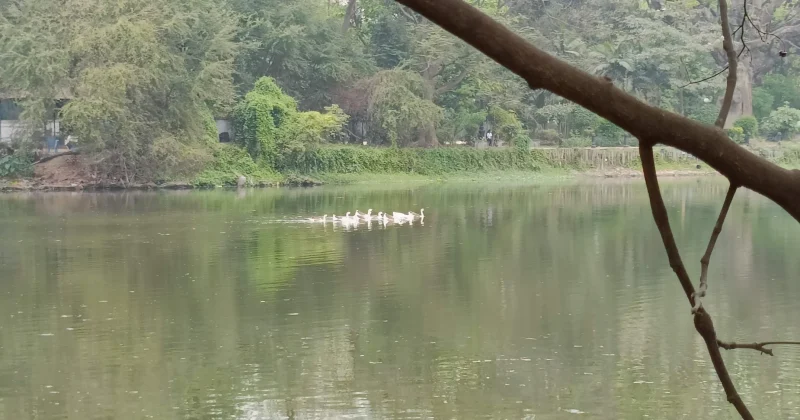
One of the bird-inhabited islands (PC: Pratyay Kanjilal, 2023)
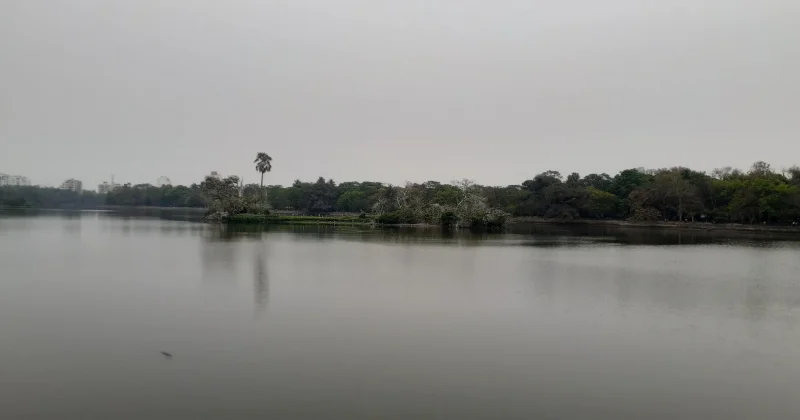
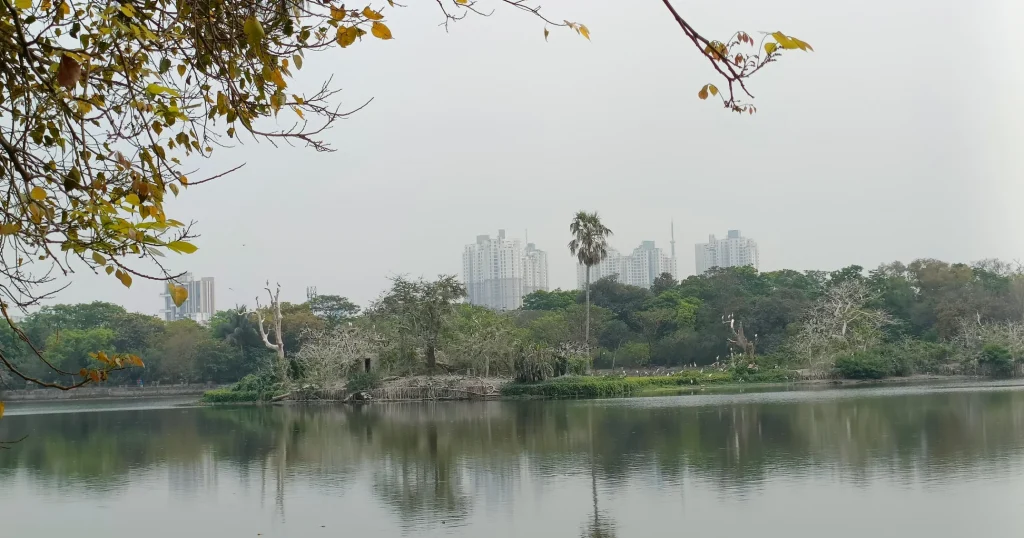
Another island in distance (PC: Pratyay Kanjilal, 2023)
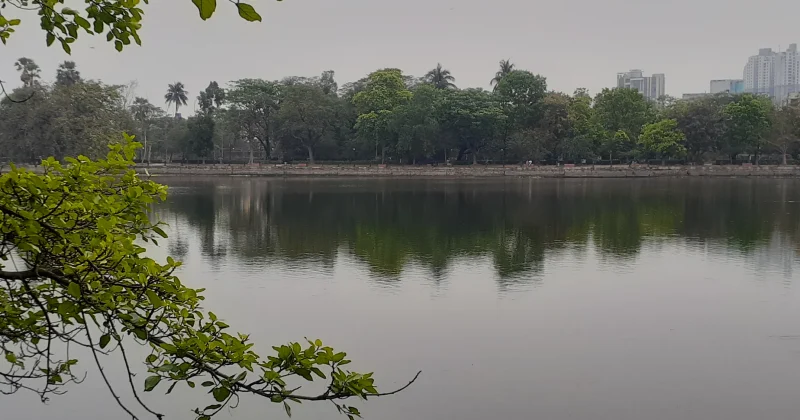
A giant mirror (PC: Shreemoyee Bag, 2023)
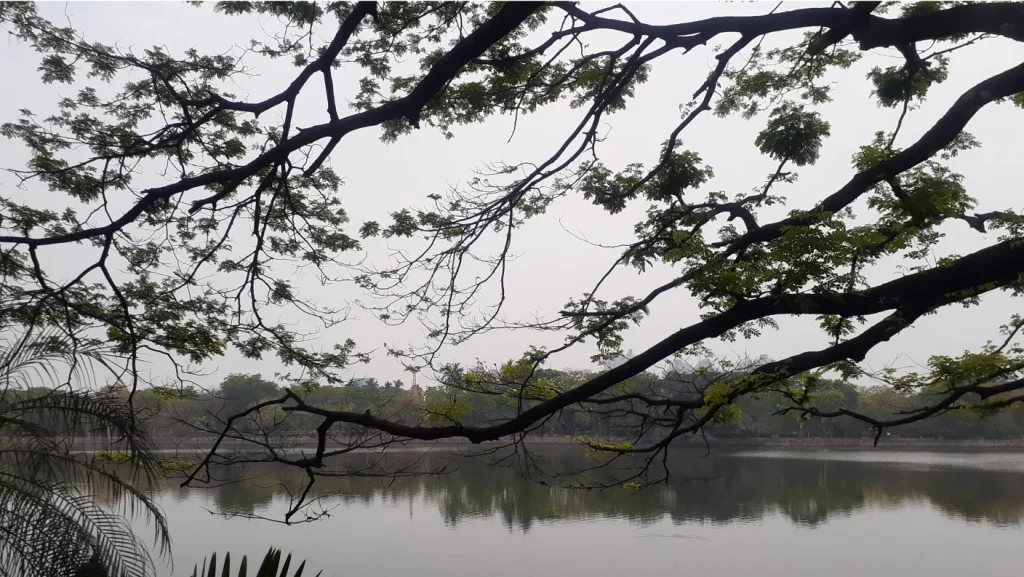
A tranquil twin existence of the green and the blue (PC: Pratyay Kanjilal, 2023)
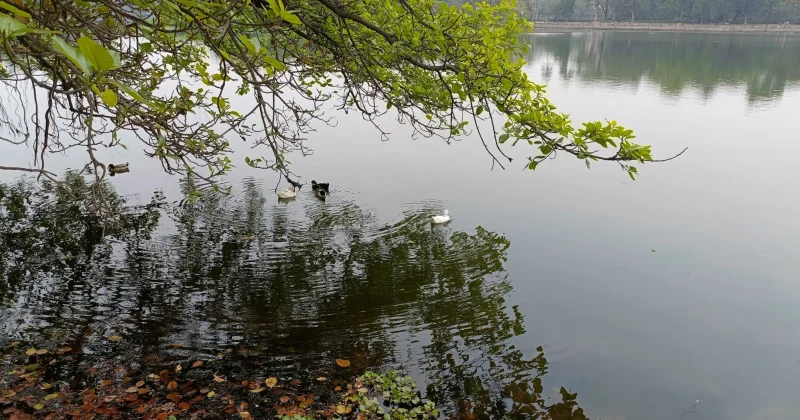
A safe habitat for birds (PC: Pratyay Kanjilal, 2023)
A safe habitat for birds (PC: Pratyay Kanjilal, 2023)
A lake, a park and much more
Nature Reserve
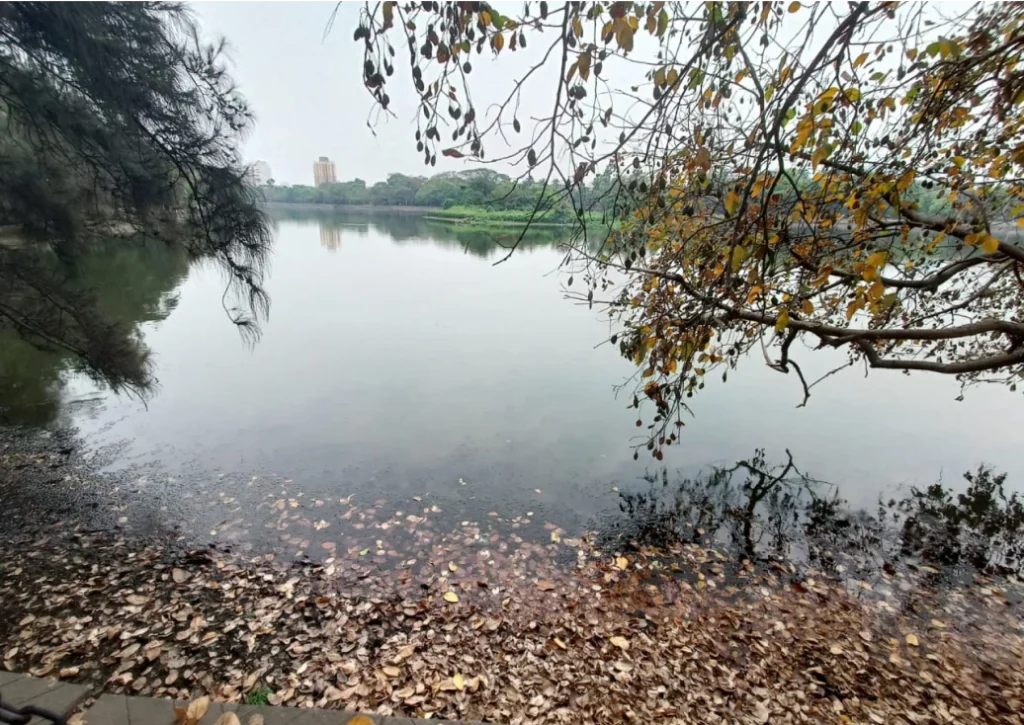
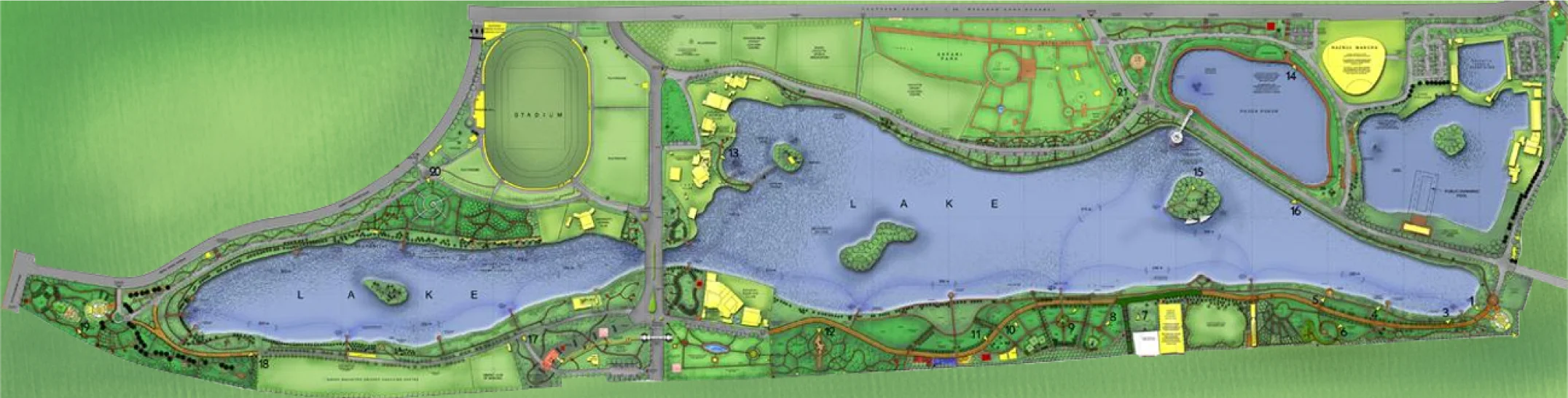
There are a total of five water-bodies, out of which the two large water-bodies constitute the main lake- the eastern one being the largest. Their average depth is about 4.0 metres, with certain deeper pockets (JU report, 2007). A fenced lotus pond is on the north, while the two others are used for swimming. The lakes have quite a few islands (retained landmasses) and most of these are undisturbed eco-habitats. A rich repository of different tree species, Rabindra Sarobar is a paradise for nature lovers.
A picturesque setting (PC: Shreemoyee Bag, 2023)
Active and Passive Recreation
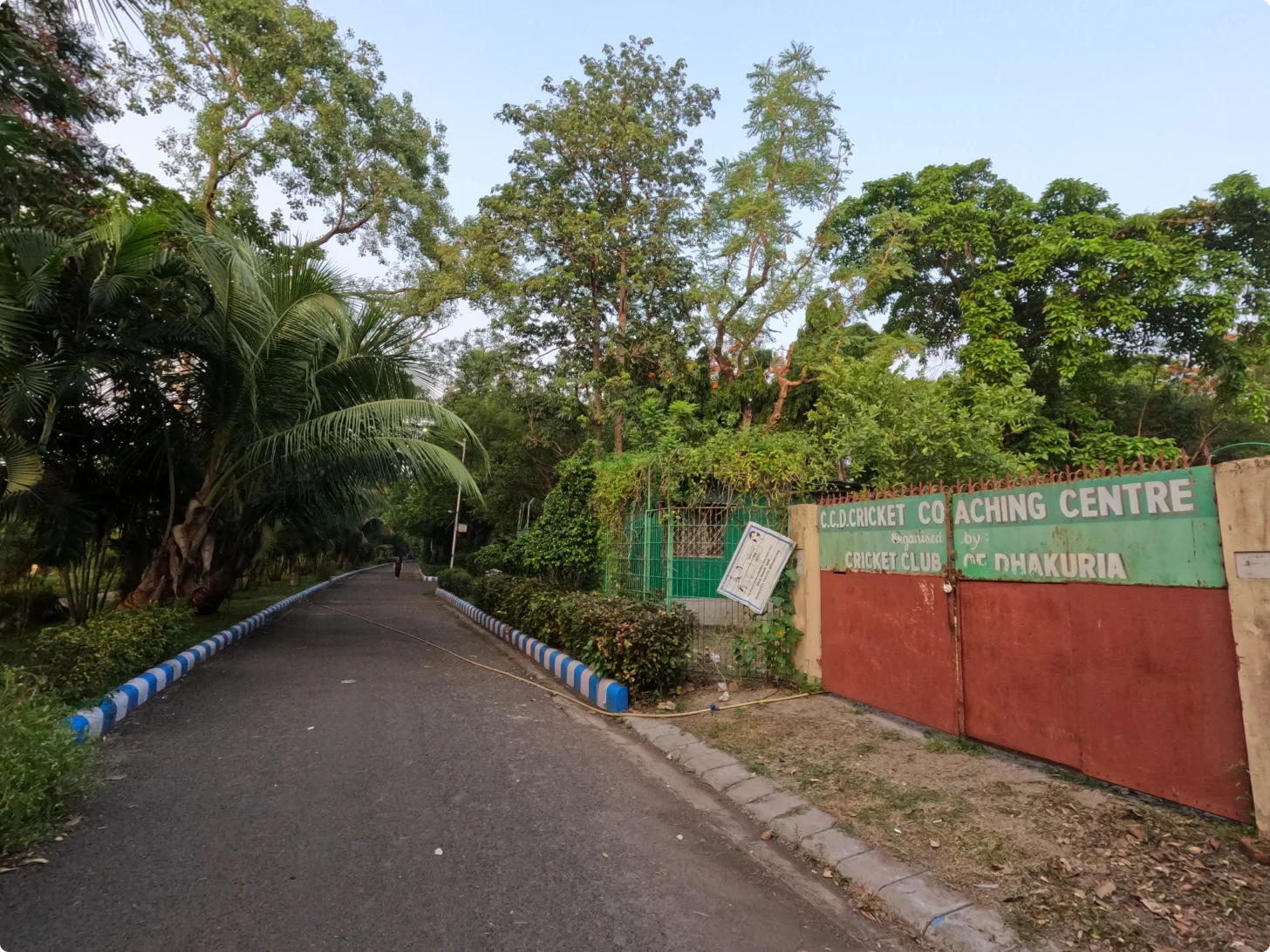
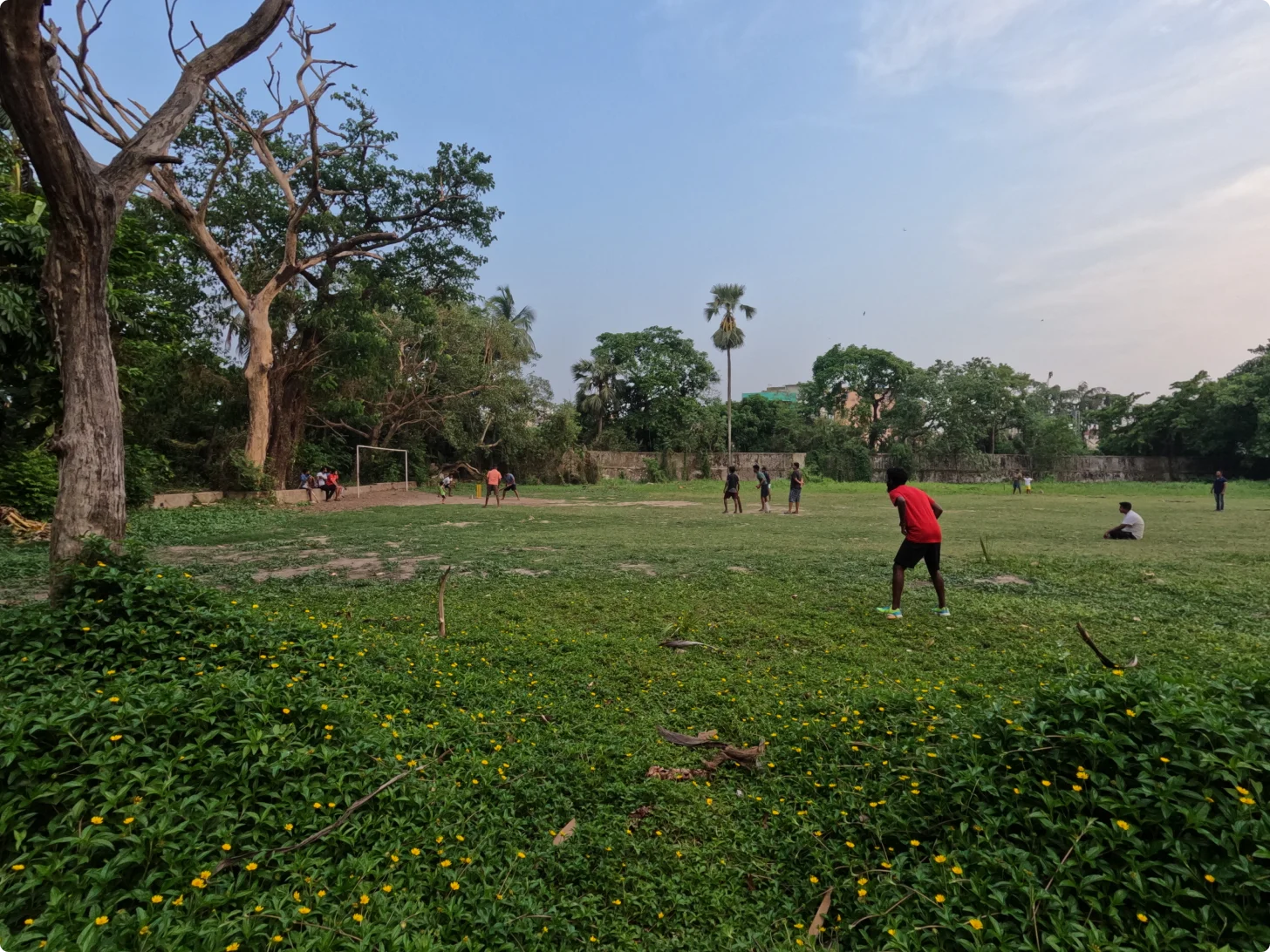
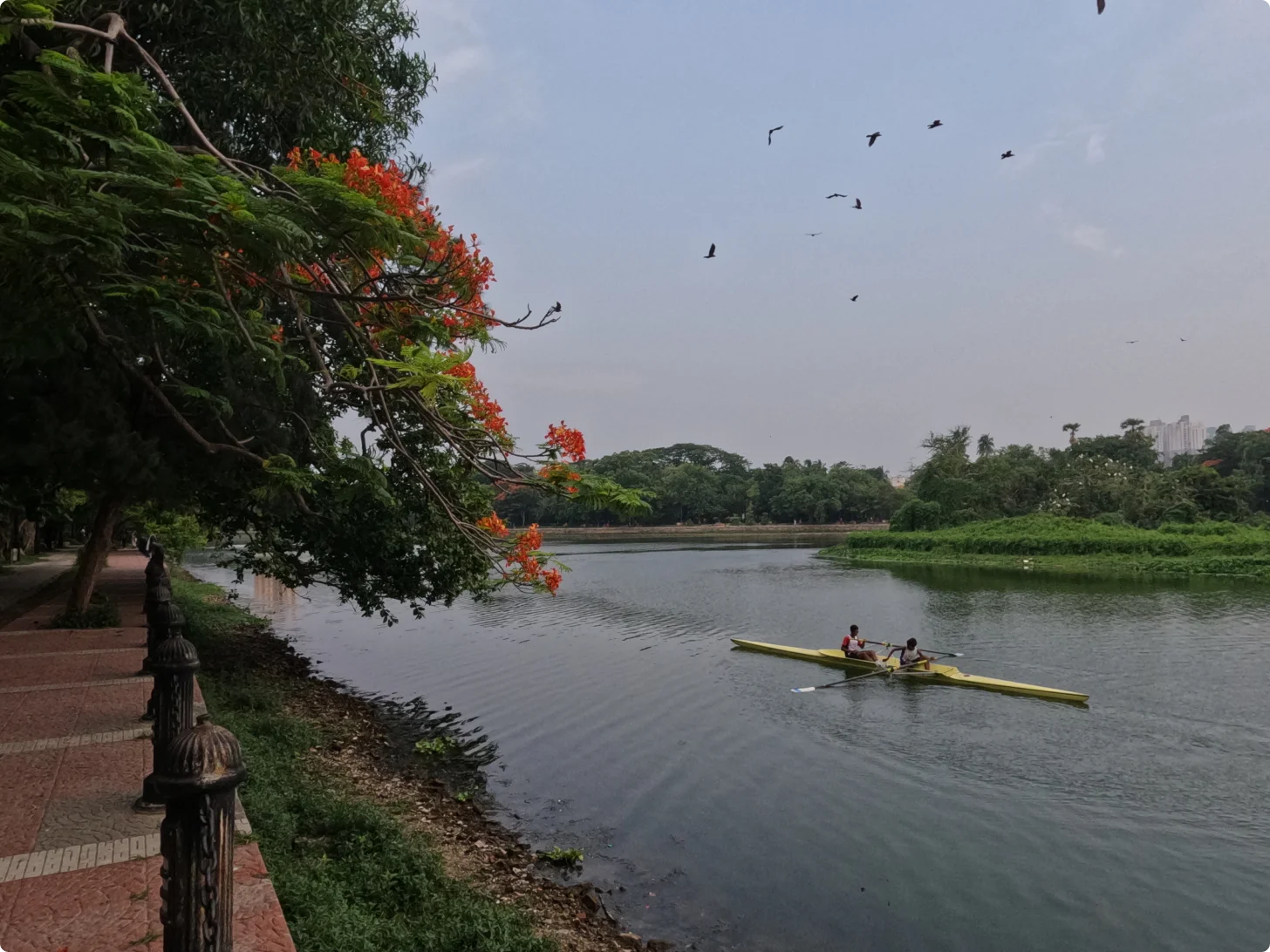
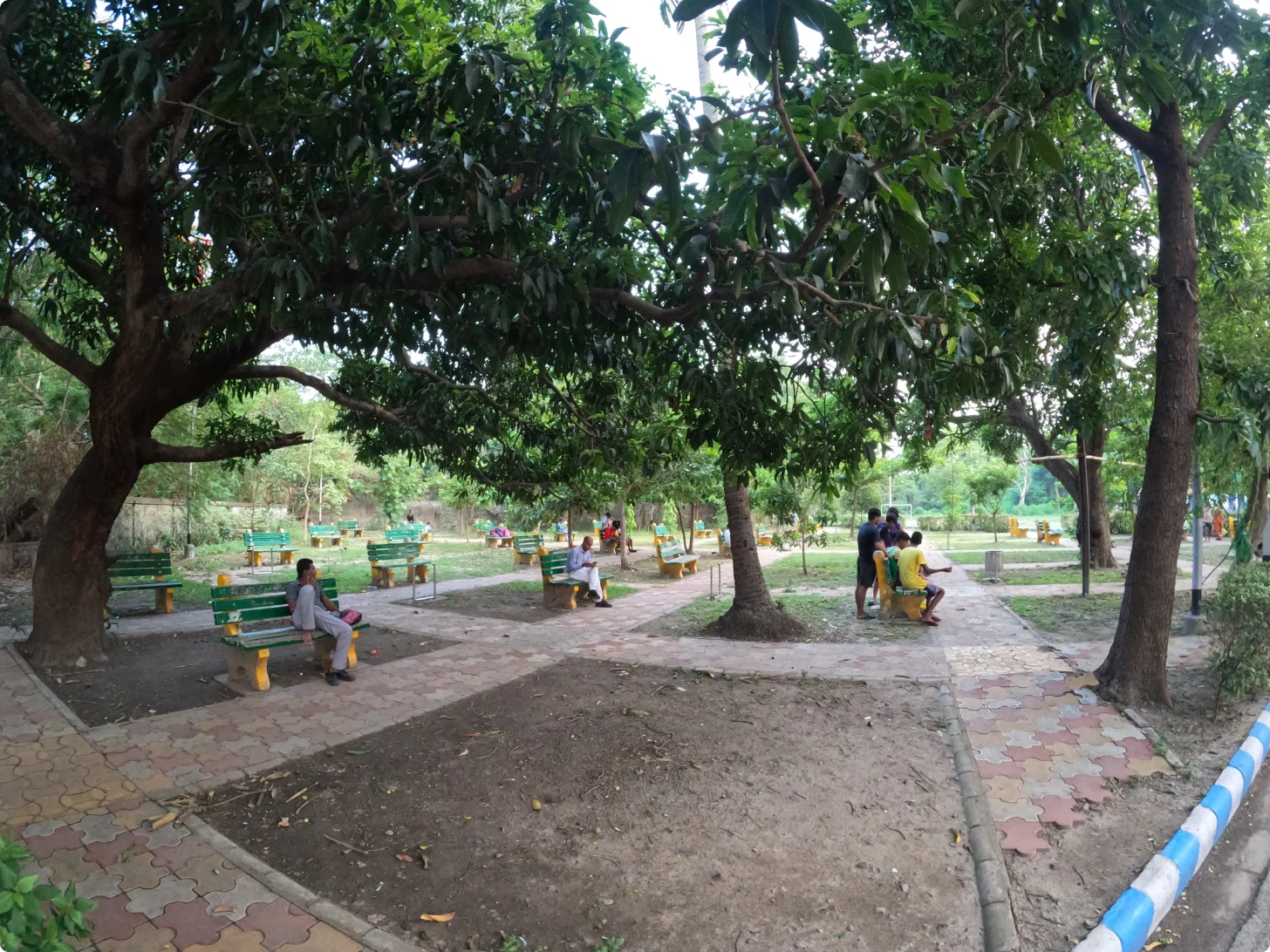
Rabindra Sarobar is a recreational hub with a multitude of clubs engaged in the sports of rowing and swimming. There is a cricket academy with practice ground(s) and a Safari park with a children’s play area & a laughing club. Walkers and joggers are a regular sight in the morning. Bird-watching has also emerged as a popular educational sport as it is one of the few go-to places within the city. Bird photography in the park has a strong social media presence too. Casual strolling and sitting by the lakeside has tremendous positive impact – relaxing and soothing both the mind and body.
One of the Rowing clubs seen in the distance (PC: Shreemoyee Bag, 2023)
History and Culture
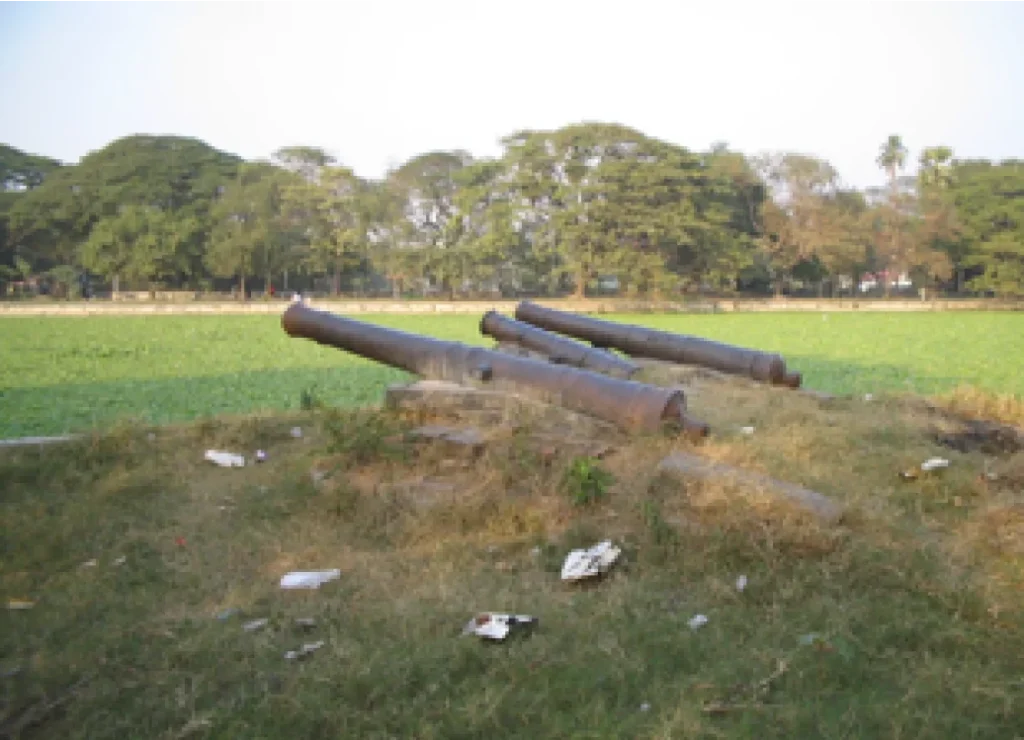
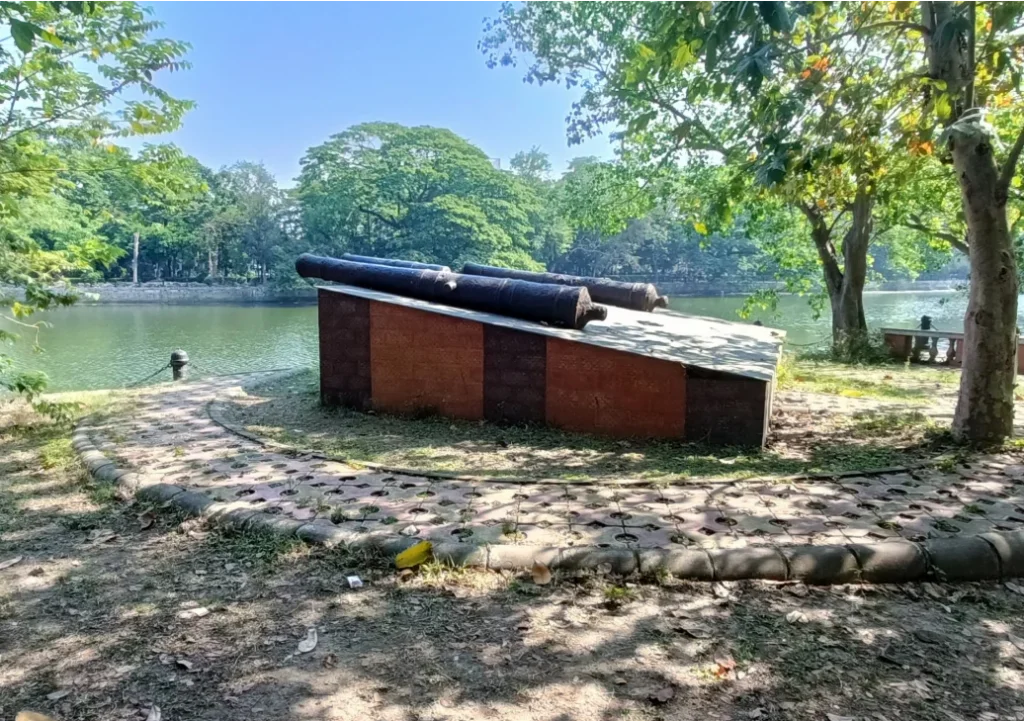
Being man-made, Rabindra Sarobar is a cultural landscape that offers opportunity to learn from nature. It also teaches us important planning lessons of the days gone-by. During excavation, CIT has literally unearthed some historic cannons, believed to be of the Nawab of Murshidabad and a part of the 1756 seige of Calcutta. However, it is also said that these cannons might have been found elsewhere and were brought here as part of added ‘ornamentation’ (WBPCB, 2017).
Old cannons atop an earth mound (source: JU report, 2007)
New pedestal for the cannons (PC: Rita Mahato, 2023)
Ecology and Environment
Rabindra Sarobar is the much needed green breathing space in the dense urban greyness – a cool pocket in a ‘heat island’. The aquatic-cum-terrestrial ecosystem services and the direct & indirect environmental benefits that we derive from Rabindra Sarobar are immense and innumerable. A treasure trove of urban bio-diversity, it re-establishes connection with nature and induces biophilia & mental well-being in human users,
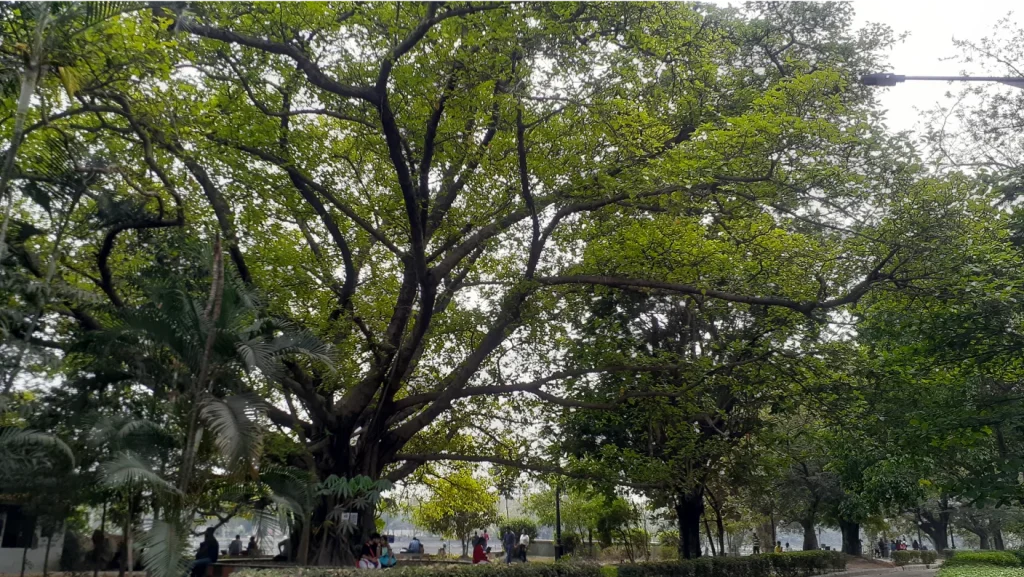
A tree that reminds of nature’s supremacy (PC: Shreemoyee Bag, 2023)
A Journey of Endurance
Recognizing the ecological and environmental significance of the lake, the National Lake Conservation Programme of Government of India has declared Rabindra Sarobar as a National Lake in 2003, the first lake in West Bengal to receive this status.
Rabindra Sarobar has been enduring a lot since long. It has seen encroachments, consequent land & water pollution, long drawn legal battles fought by environmental activists for a pollution-free lake, and finally a squatter-free site in 2006. A multi-disciplinary team of experts from Jadavpur University conducted a study of Rabindra Sarobar at the behest of Kolkata Improvement Trust (KIT) in 2007 and prepared a Comprehensive Rejuvenation Plan (CRJP) for the lake and its adjoining park area. An over-all assessment of land-use, water, landscape, and environmental challenges was carried out based on which a phase-wise landscape development road-map and guidelines were prepared. With a strong central theme revolving around Tagore’s perceptions, the CRJP aimed to address the spatio-physical, socio-cultural, ecological, environmental, and economic challenges with its innovative three-tiered concept including the proposition of ‘Fee-zone & Free-zone’ for better management.
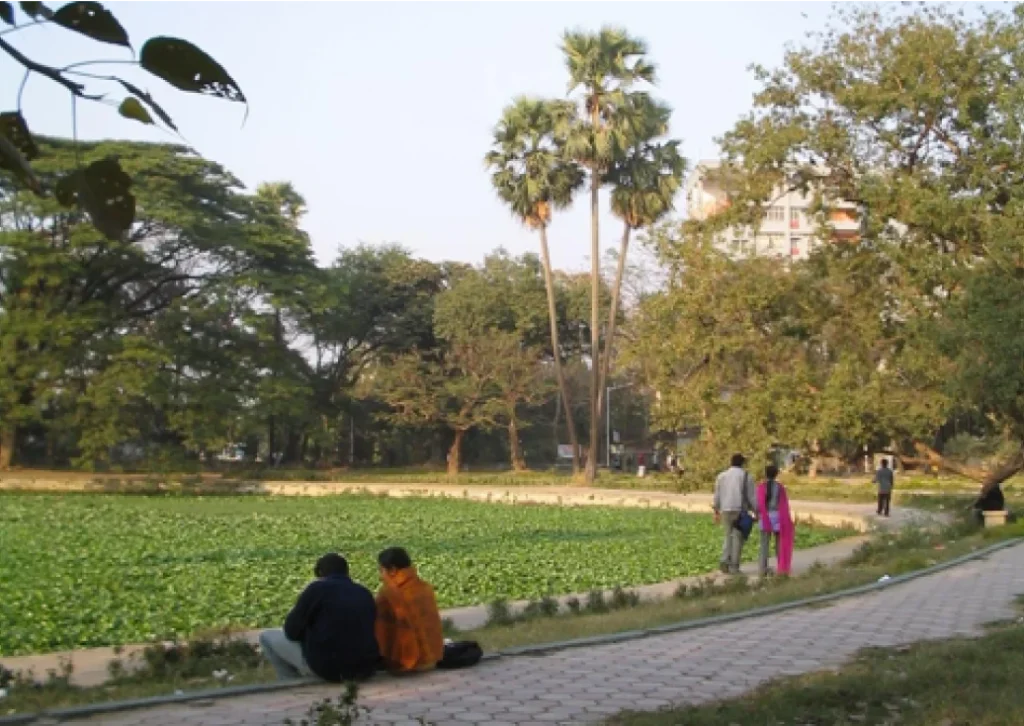
Lake ovegrown with water hyacinth (source: JU report, 2007)
Notable improvement in the quality of lake water, 2023 (PC: Rita Mahato)
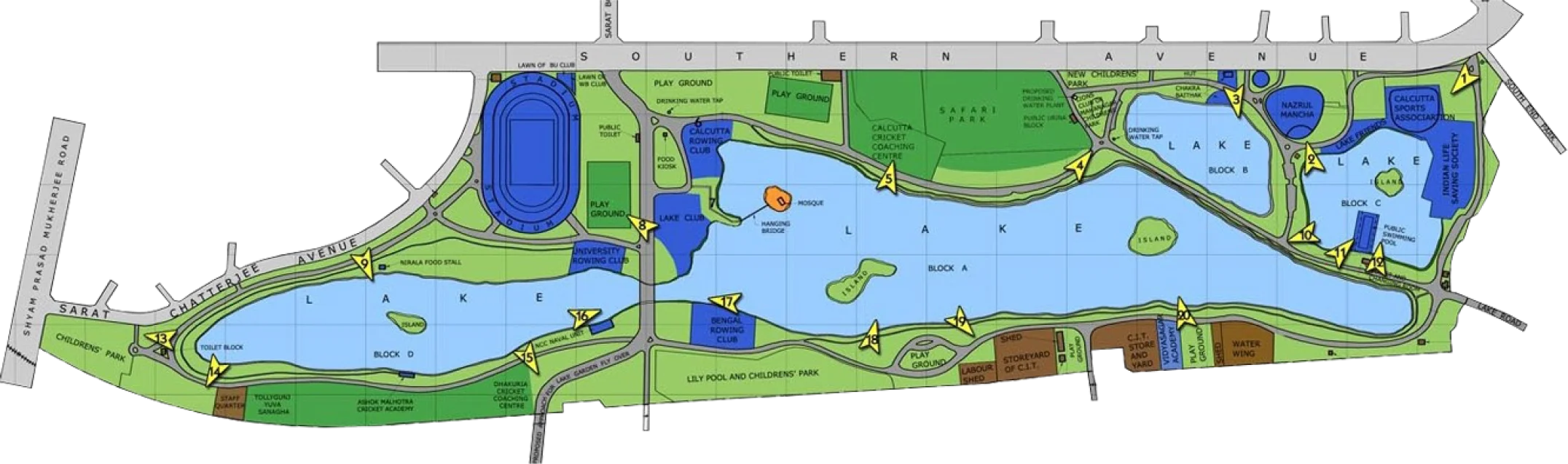
Land uses within Rabindra Sarovar park area, 2007
Proposed comprehensive landscape plan, 2007
A Promising Present
After a decade and some phased-implementation of the CRJP, an Environmental Impact Assessment study was carried out by West Bengal Pollution Control Board (WBPCB) in 2017 on an National Green Tribunal (NGT) order.
This study (WBPCB, 2017) has reported “a total of 366 species of terrestrial vascular plants in the life form of 162 trees, 8 lianas, 14 climbers, 46 shrubs and 136 herbs have been identified from Rabindra Sarobar and its premises. The 366 species were distributed under 277 genera and 43 families.” This is a marked improvement from the 2010 study reported in the same document, as “a total of 152 species of vascular terrestrial plants’ of 73 tree species, 2 lianas, 4 climbers, 7 shrubs and 66 herb species, under 127 genera and 53 families.
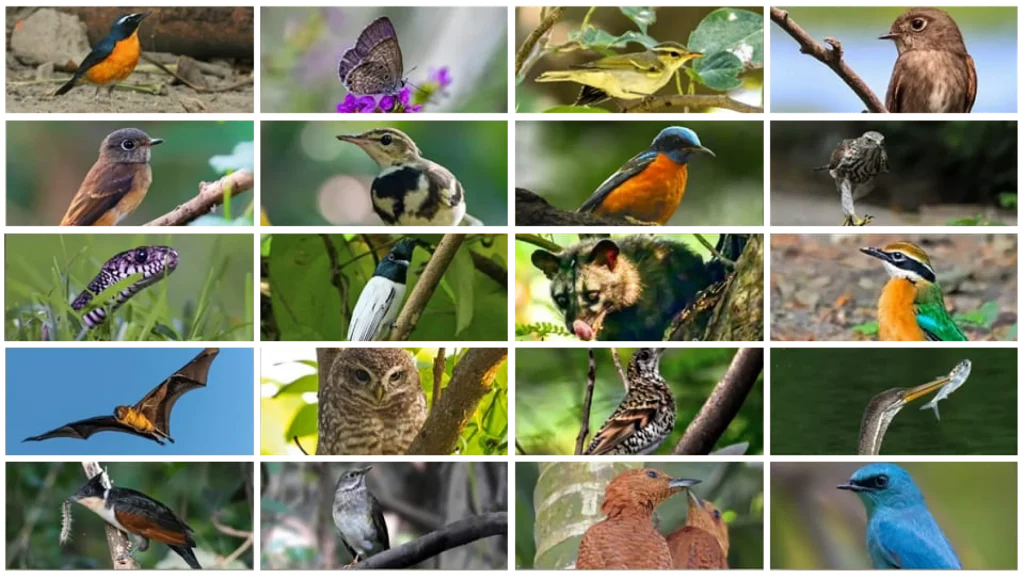
Besides trees, the study has also recorded 57 butterfly species, 107 bird species (69 resident, 23 long-distant migrant, 14 local, 52 migrant, and one summer visitor), and 40 freshwater fish species. These are important bio-diversity indicators and show that the rejuvenation plan has been working well.
A peek at the bird diversity in Rabindra Sarobar, 2022 (PC: Sudip Ghosh, Facebook group on Rabindra Sarobar, retrieved on 31.03.23)
Rabindra Sarovar at Dusk
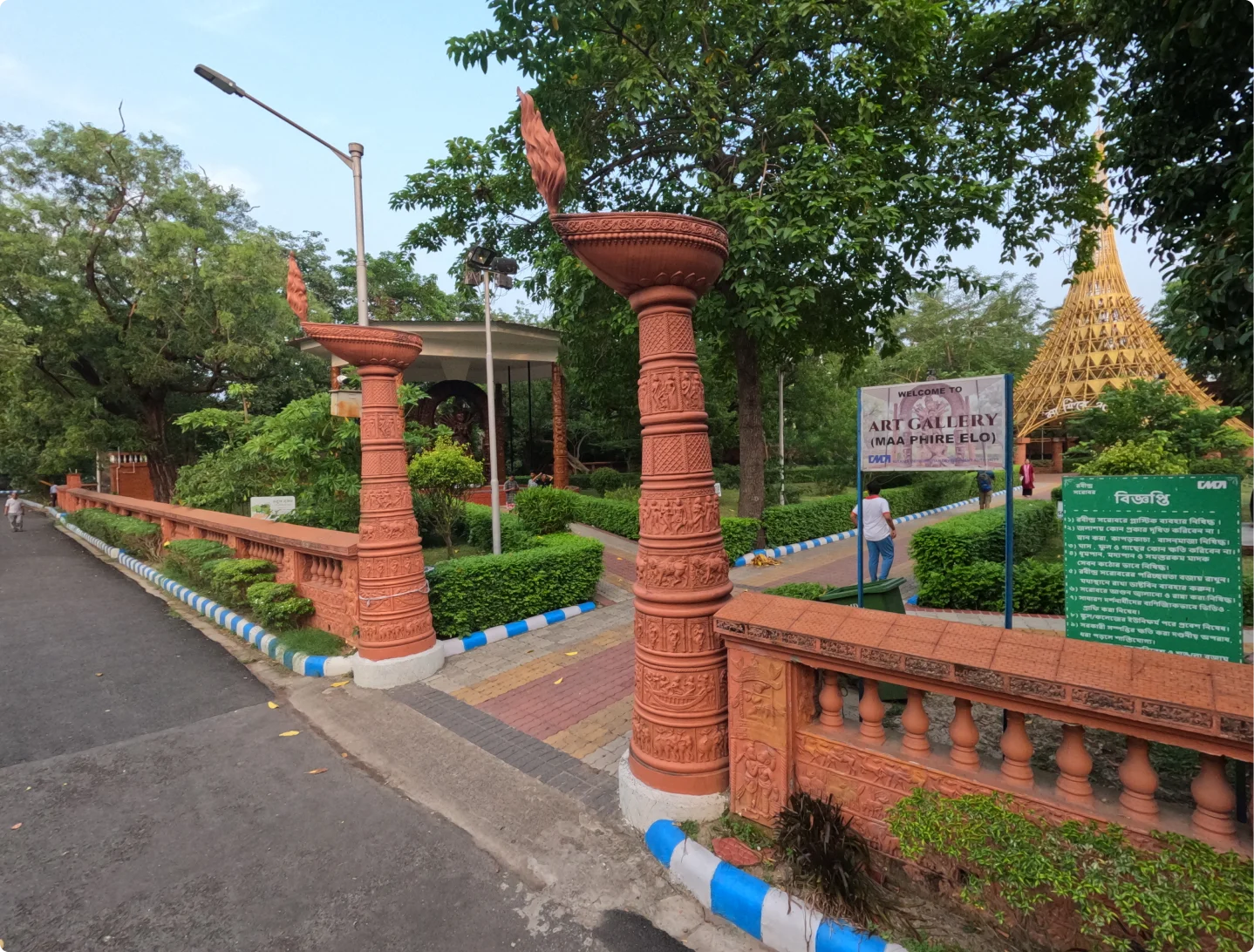
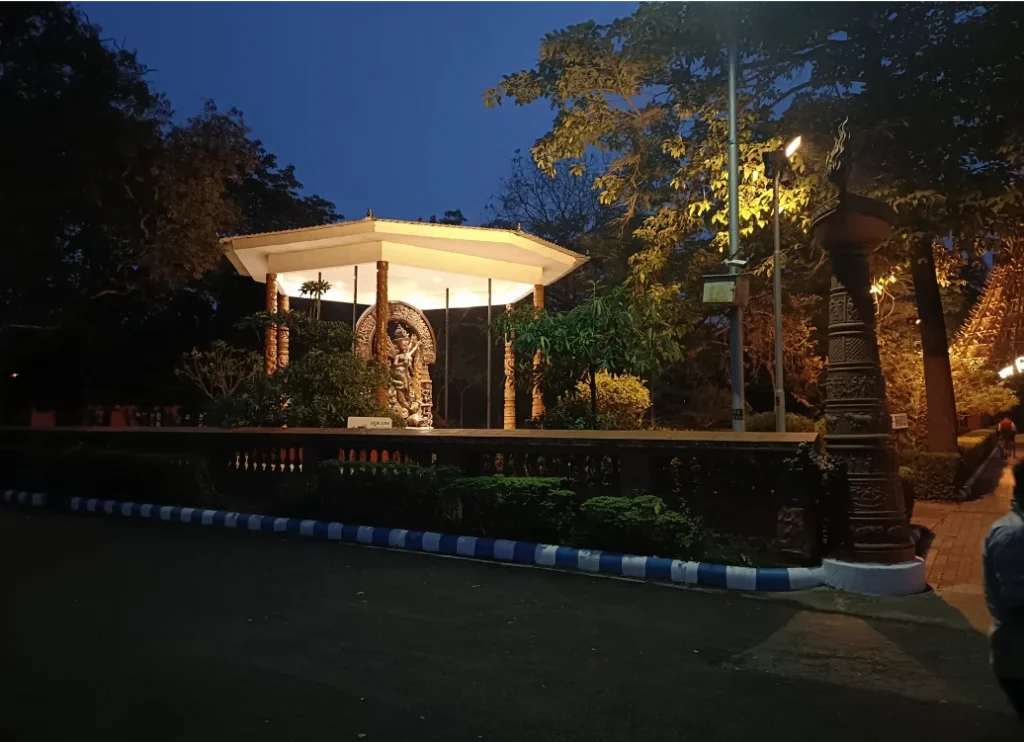
Cultural court proposed in the CRJP, 2007 has been implemented by installing award-winning clay idols of Goddess Durga, suitably sheltered and illuminated. (PC: Rita Mahato, 2023) Note: UNESCO has inscribed ‘Durga Puja in Kolkata’ on the Representative List of the Intangible Cultural Heritage of Humanity in 2021. (Inscription: 16.COM 8.b.15)
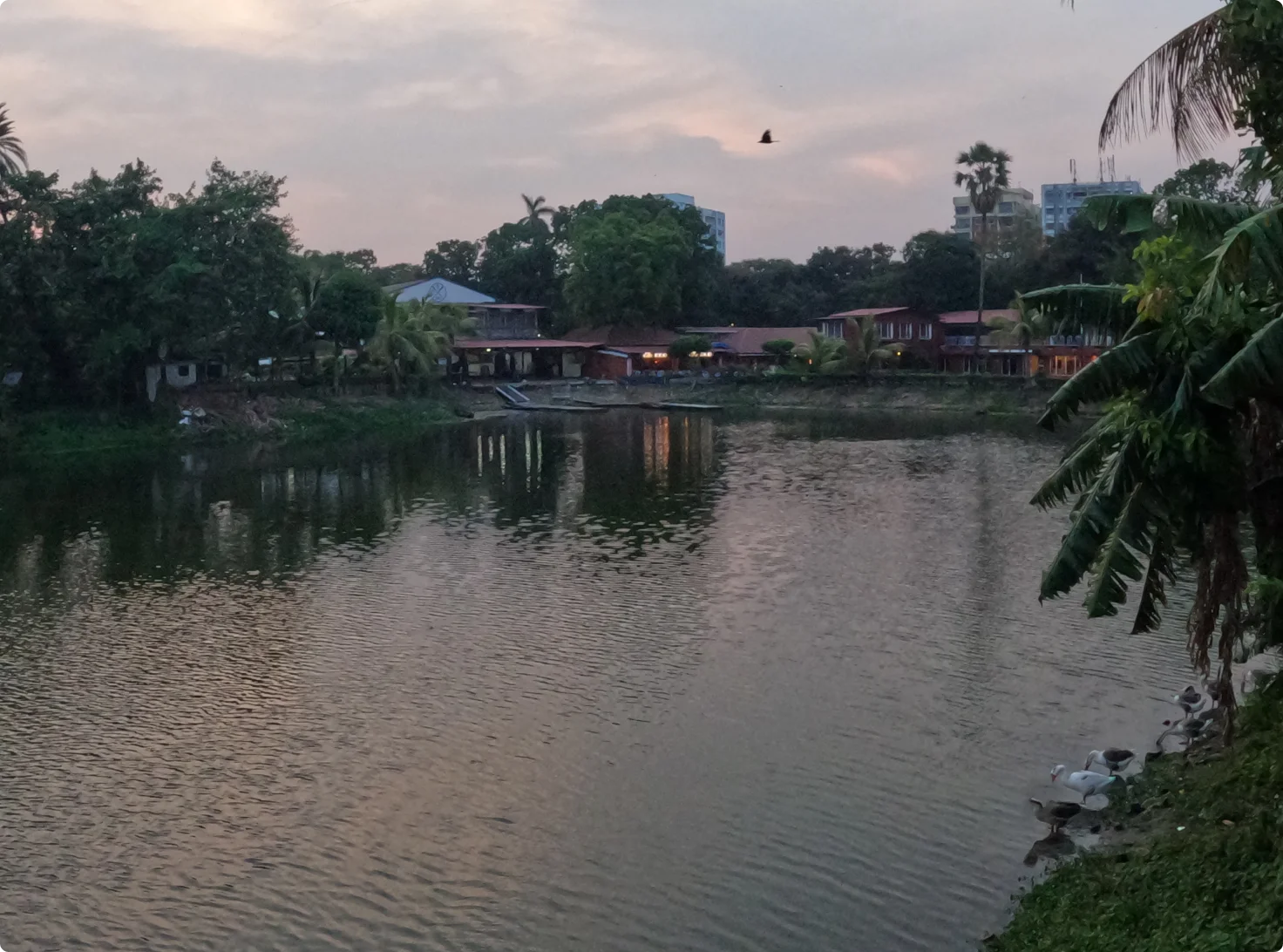
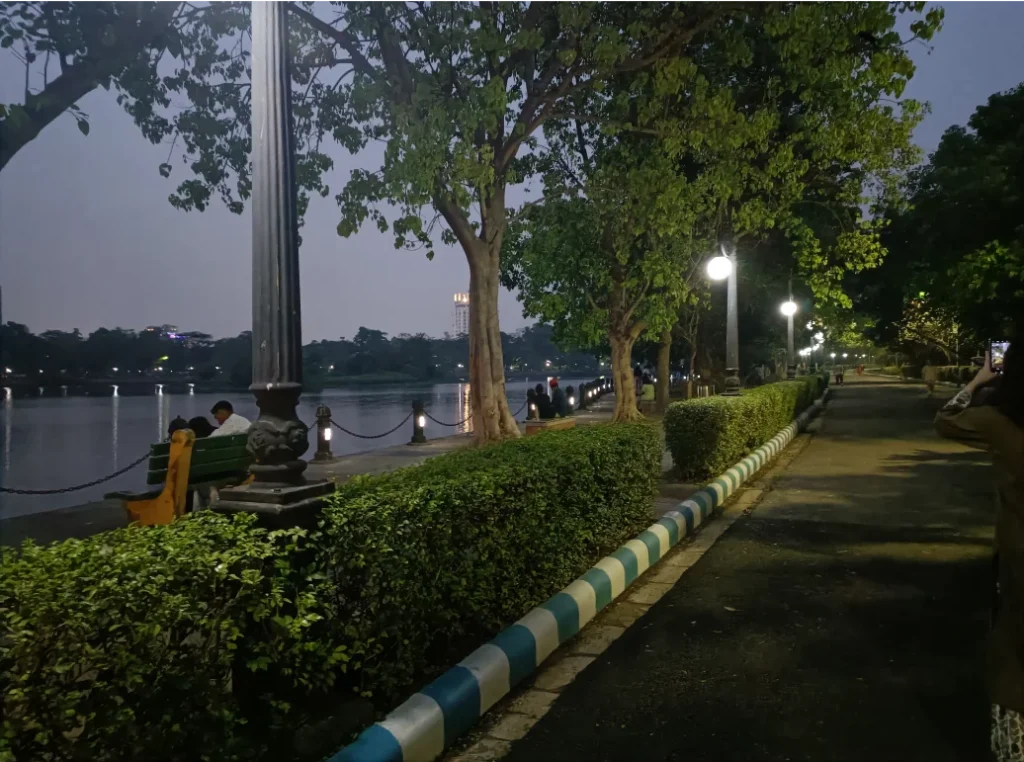
Calm and serene lake environs in the evening (PC: Rita Mahato, 2023)
Way Forward….
While the past developments in the lake precinct were conceived mainly as engineering projects (Mody and Saraogi, 1989) and creation of recreational amenities to generate revenue, the turn of the millennium under a changed climatic context demands careful attention to the ecological and cultural values of the site with clear environmental conservation goals.
Although the lake environment has undergone remarkable improvement in the last few years, occasional onslaught on the lake ecosystem; intense public activities in the park, especially after dark; over-illumination in certain pockets; damaged green cover, and pollution concerns still remain. Augmenting plantations and continuous care of the existing greeneries with the core objective of ecosystem restoration is key to help this century-old national lake move on the path of long-term sustainability.
Looking eastwards: Aerial view of Rabindra Sarobar, 2019 (PC: Oh Kolkata Facebook group, retrieved on 31.03.23)
References
Chattopadhyay, M., (2013), Paschim Banger Porikalpita Nagarayan.